






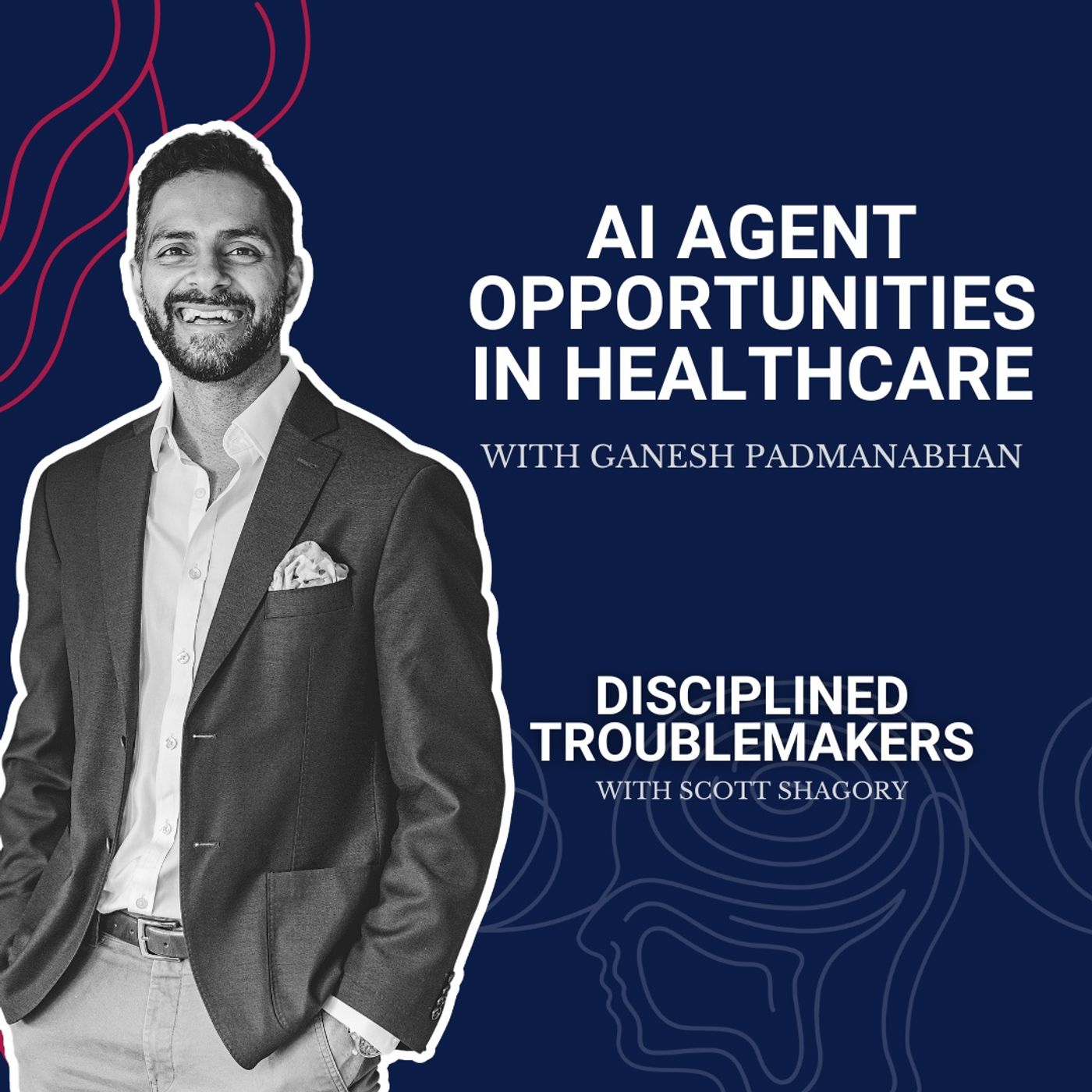
The healthcare technology landscape is littered with well-intentioned solutions that failed to deliver meaningful impact. In a recent Disciplined Troublemakers Podcast interview with Ganesh Padmanabhan, CEO and founder of Autonomize.AI, we explored what it takes to build healthcare AI that works and scales sustainably.
The Unstructured Data Challenge: Bigger Than You Think
Healthcare organizations are sitting on a goldmine of untapped insights, but it’s not where most people think. While many focus on structured electronic health records, Padmanabhan revealed a reality:
80-90% of healthcare data is completely unstructured.
“Medical charts, lab reports where somebody actually explains their findings, care management notes, call transcripts, all of that is unstructured data,” he explained. “The nuance is that it’s not only unstructured, it’s also highly contextual. The same medical chart reviewed by a pharma clinical researcher versus a visiting physician will be analyzed for completely different contexts.”
This presents a fundamental scaling challenge that goes beyond traditional data processing approaches. It requires deep domain expertise, sophisticated AI models, and an understanding of how different healthcare workers actually use information in their daily workflows.
From Problem Validation to Operational Scale
Autonomize.AI’s growth trajectory offers valuable insights for any technology company scaling in complex, regulated industries. Over three years, they’ve grown from two founders to over 60 team members across multiple countries, working with life sciences companies, health plans, and hospital systems.
Their scaling approach followed a disciplined progression:
Year 1: Problem Validation and Team Assembly
- Focus on finding meaningful problems with maximum impact
- Assembling a mission-driven early team over purely talent-driven hiring
- Extensive customer discovery across the healthcare spectrum
Year 2: Product-Market Fit and Sustainable Value
- Building conviction around specific use cases
- Ensuring solutions deliver measurable business value
- Avoiding the common AI trap of building impressive demos that don’t integrate into real workflows
Year 3: Operational Scaling and Culture Building
- Expanding internationally with teams in Austin, Canada, and India
- Implementing systems and processes to maintain culture across geographies
- Preparing for next-stage growth and funding
The Real Value Proposition: Augmenting Knowledge Workers
What sets Autonomize.AI apart from typical “AI for healthcare” companies is their focus on knowledge worker productivity rather than patient-facing applications. Healthcare’s most valuable resources are doctors, nurses, care managers. Yet, they spend 50-60% of their time on administrative tasks.
“We give them an AI sidekick that helps make their workflows more efficient,” Padmanabhan explained. “Instead of waiting three weeks for a prior authorization decision, you get it done in minutes because there’s more efficiency in how humans are adjudicating it.”
This approach delivers measurable outcomes:
- Operational P&L improvement: 30% reduction in SG&A costs for knowledge work
- Cycle time reduction: From weeks to minutes for critical processes
- Provider satisfaction: Healthcare workers go home less exhausted and more fulfilled
Beyond Vendor Proliferation: Platform Thinking
One of the most insightful aspects of our conversation was Padmanabhan’s critique of healthcare’s “siloed problem solving” approach. Large health systems often end up with hundreds of point solutions, 500 different telehealth vendors, for example, because the industry has institutionalized vertical integration for every specific problem.
“What we wanted to do was build a platform company that goes deeper into workflows,” he said. “At the heart of all of this is the patient. If you can structure all that data as it relates to a patient’s journey, you can unlock efficiencies across the entire spectrum.”
This platform approach creates network effects and sustainable competitive advantages that point solutions cannot achieve.
Scaling Lessons for Tech CEOs
Several key insights emerged from Autonomize.AI’s scaling journey that apply broadly to technology companies:
Mission-Driven Hiring Scales Culture: Even at 60+ employees across multiple time zones, new hires demonstrate ownership mindset and energy that wasn’t directly instilled by leadership. This stems from consistent reinforcement of mission and values from day one.
Customer Partnership Over Product Pushing: The most successful scaling happens when customers become genuine partners in solution development. “We challenge them when they ask questions,” Padmanabhan noted. “We’ll tell them what’s wrong and why everyone who writes blogs about it usually doesn’t know what they’re doing.”
Focus on Business Value, Not Technology Hype: In an AI market full of noise, sustainable companies differentiate by delivering clear ROI. “We want to provide the shortest path to get you value,” rather than getting caught up in the latest model releases or technical capabilities.
Build Trust Through Giving More Than Taking: Especially for early-stage companies, every customer interaction must leave the other party better off. This is particularly critical in healthcare, where trust directly impacts patient outcomes.
The Path Forward
As healthcare continues to evolve, the companies that will drive meaningful change are those that combine technological sophistication with deep operational understanding and genuine mission alignment. Autonomize.AI’s journey demonstrates that sustainable scaling in complex industries requires patience, discipline, and unwavering focus on real-world value creation.
For technology CEOs looking to scale in healthcare or other knowledge-intensive industries, the lesson is clear: start with the humans, understand their workflows, and build technology that amplifies their capabilities rather than replacing their expertise.