






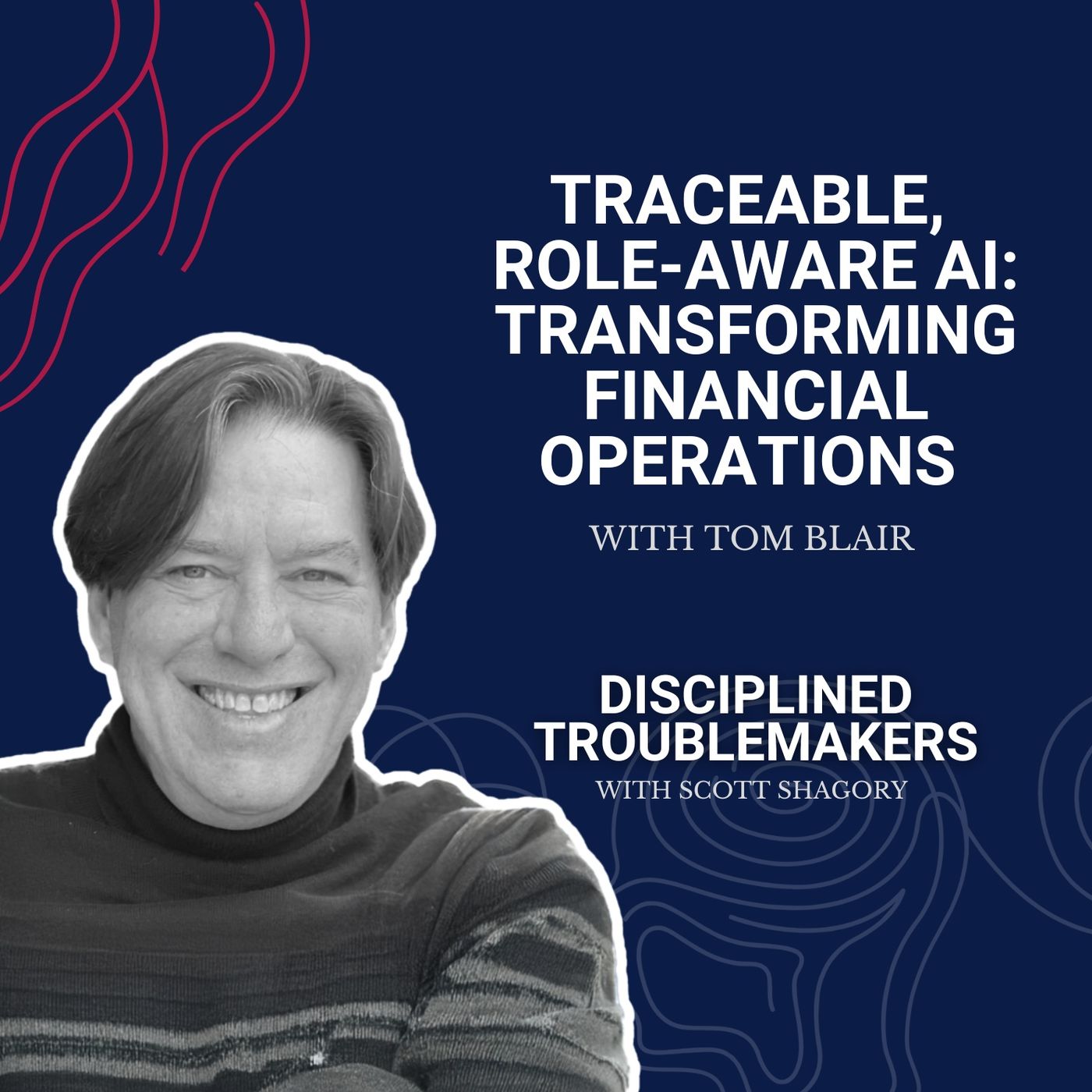
In our latest episode of the Disciplined Troublemakers podcast, I sat down with Tom Blair, CEO and co-founder of iClerk.ai, to explore how AI agents are transforming enterprise workflows. We started with the least glamorous parts of business: the critical but repetitive tasks that frustrate teams and drain resources.
Founded in 2019, iClerk builds autonomous, role-based AI agents designed to streamline complex financial processes. These aren’t chatbots. They’re cognitive assistants designed to handle LP reporting, NAV calculations, fund admin workflows, and more. And unlike many AI implementations, iClerk’s agents are traceable, auditable, and secure as these are core requirements for highly regulated environments like finance, insurance, and nonprofits.
Tom’s thesis is simple: most companies don’t need a moonshot, they need relief. His first customers weren’t seeking AI innovation. They were trying to stop analysts from quitting over spreadsheet drudgery. “It wasn’t the brilliance of AI that won them over,” Tom told me. “It was retention.”
This is where iClerk’s approach shines. Instead of pushing a top-down AI transformation, they focus on atomic units of work which are small, well-defined tasks. Each agent handles one job, like compiling a Schedule of Investments or automating K-1 generation. The implementation is fast (often under 100 man-hours), non-invasive (customer data stays put), and low-risk (iClerk doesn’t charge until it works).
This tactical, workflow-first mindset avoids the “religious fervor” often associated with AI adoption. It also enables exponential operational leverage. As Tom shared, “Once a company sees one agent deliver value, they quickly want three more.”
From a scaling perspective, iClerk is expanding along two key vectors:
- Market Reach: Starting with VCs, they’ve expanded into private equity, family offices, 501(c)s, and public SMBs as each face similar statutory and reporting burdens
- Agent Proliferation: Once embedded, customers find additional use cases. The economics are compelling, such as ten agents for the cost of one professional hire and the ROI is rapid
Underpinning all this is decades of experience. Tom and his co-founders aren’t twenty-somethings chasing trends. They’re veterans with institutional knowledge, deep networks, and a long view understanding of enterprise pain. That maturity has led to a distributed model built on trust, connection, and asynchronous collaboration, run entirely without a traditional office.
As we wrapped our conversation, Tom shared a powerful sentiment:
“Humans are bad at exponentials. But AI is moving at 4–40x improvements per year. You can’t predict the future. You can only take the next step.”
That grounded perspective is exactly what makes iClerk worth watching. They’re not chasing AI hype. They’re solving real problems and quietly transforming how work gets done.
And they’re doing it one step and one agent at a time.