






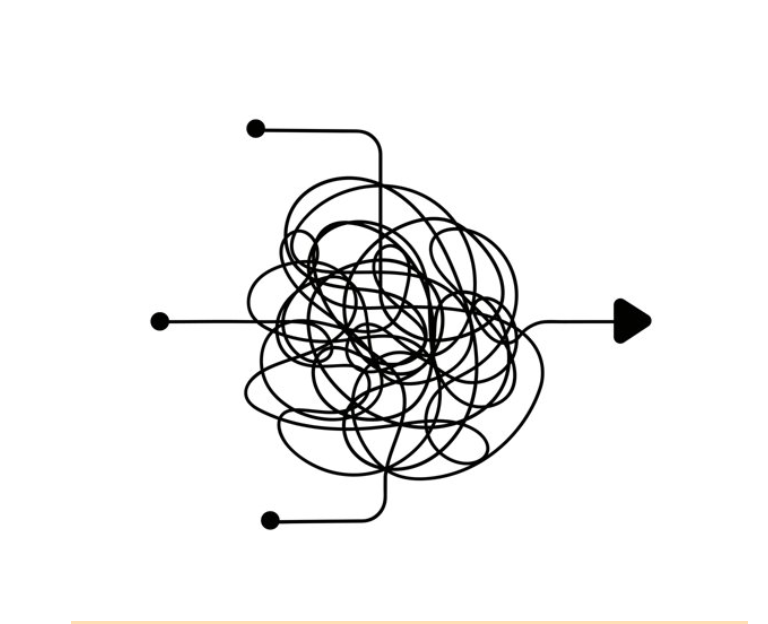
We all understand people dislike uncertainty. Whether it’s feelings of anxiety or fear, a world marked by precariousness and a lack of predictability often paralyzes decision-making and interrupts forward movement. Most will go to enormous lengths to minimize uncertainty in their personal and professional lives.
At the same time, we all also understand stability is an illusion. Whether that’s via intuition, practical experience, or understanding the basics of chaos theory, people recognize the variability of our world.
Tech CEOs in particular juggle an interesting paradox in the chaos. First is their company’s disruptive stance which is actively introducing instability into a marketplace. Second, they’ve chosen to embrace and harness the turbulence within a market without attempting to control it. Finally, they’ve established an unshakable commitment to an opportunity they have discerned in the chaos to reshape what’s possible.
Here’s a visual model to root the idea:

White Belt Approach to Chaos: Reaction and Decision Paralysis
There are several classic pitfalls leaders place themselves and their teams in that consistently immobilizes decision-making.
The Data Trap is when uncertainty grows there’s a demand for more and more data. Everyone digs in hoping to find a kernel of insight that will shift their paradigm and create safety to move forward. Often this approach simply introduces more complexity, which is always self-fulfilling.
Consensus Decision-making sneaks in when there’s a perceived need for validation. Humans find comfort in knowing others view a challenge in the same way. But diffusing responsibility across committees produces watered down, middle of the road decisions and this process often accelerates when the first cycle of consensus doesn’t solve the problem.
The Perfect Solution doesn’t exist, but many work exceptionally hard to find it in chaotic, high-pressure environments. The idea of perfection is too strong to ignore, and it makes people feel safe, even when it kills momentum and decision-making.
Black Belt Approach to Chaos: Awareness and Controlled Mastery
In any martial arts, the most fearsome opponent isn’t the person who strikes the hardest but the one who is most aware. That awareness is the foundation of effective decision-making in chaos. Awareness enables one to sense shifts in energy, tempo, and tone.
The same is true in business where awareness enables one to discern shifts in the competitive landscape, anticipate unseen threats and recognize emerging opportunities before they become obvious in the market.
Directional Accuracy simply means choosing a north star and moving in its direction. Recalibrations are expected, healthy, and safe. If design is the first signal of intent, movement is a commitment to act, and action creates momentum to adapt and grow.
Decision Frameworks are adaptive and create resiliency. Like shoots of bamboo, they can bend in a storm without breaking. Built into frameworks is reversibility, speed of implementation, and aligning clarity of purpose.
Time Blocking is critical because undefined timelines are damaging to forward movement. Defining what low, medium, and high impact decisions are within the company and attaching specific time limits – such as 24 hours for low impact – simplifies what’s at stake. The cost of delay is often higher than the cost of taking action.
A good question to ask:
“If this fails, what will we have learned and can we afford this education?”
The CEO as a Martial Arts Mentor
As a CEO you are leading targeted disruption in your market, which means understanding the landscape and consciously choosing to break certain rules at key points in time to create opportunities.
Practical points that make a real difference:
Chaos is a Permanent Condition so building awareness and concrete capacity within your team to thrive in the uncertainty makes a world of difference.
Embracing Imperfect Action means making small, calculated moves, pragmatically assessing results, and refining your approach as you learn more over time.
Seeing Bigger Patterns backed by a powerful idea about the future led you to found the company. Continuing to look for the deeper shifts allows for proactive positioning rather than reactive scrambling.
Embracing chaos as a natural state, rather than an exception or an anomaly, means seeing the uncertainty as something to appreciate, respect, and influence as a set of conditions.
Significantly, chaos is a breeding ground for innovation and unconventional thinking. Just as martial arts practitioners practice under stress to refine their ability to act instinctively, CEOs and their teams can condition themselves to remain composed in dynamic environments. The key is to move with precision, iterate in a timely manner, and refine your strategy in motion.
“In the midst of chaos, there is also opportunity.” – Sun Tzu
The mastery is building the clarity to see a problem has a practical, structured, organized, and repeatable solution to collapse the chaos. Creating this awareness takes time. The benefits are that you’ll always be prepared and able to see the full scope of the present moment. The value created here is priceless.
If this perspective resonates with you, contact me on LinkedIn or at scott@purplefinchgroup.com
Contact me HERE if you’d like to learn more about one of my 4-hour consults for tech CEOs. Schedule a free 30-minute conversation.
Stay focused. Keep disrupting. Be well.